What are kire and kireji?
Kire is a cut: a pause or shift between parts of a haiku. For example, a poem may describe an empty station, then a bird singing. The reader compares the quiet place with the sound.
The cut
A cut separates parts of a haiku so the reader can compare them. The parts might contrast a quiet place with a sound, or a large object with a small one. In the station example, the cut comes after the setting and before the bird’s action.
Japanese poets use kireji, or cutting words, to mark emphasis or a pause. English has no exact equivalent. English poets can use punctuation, a line break, or a change in sentence structure instead.
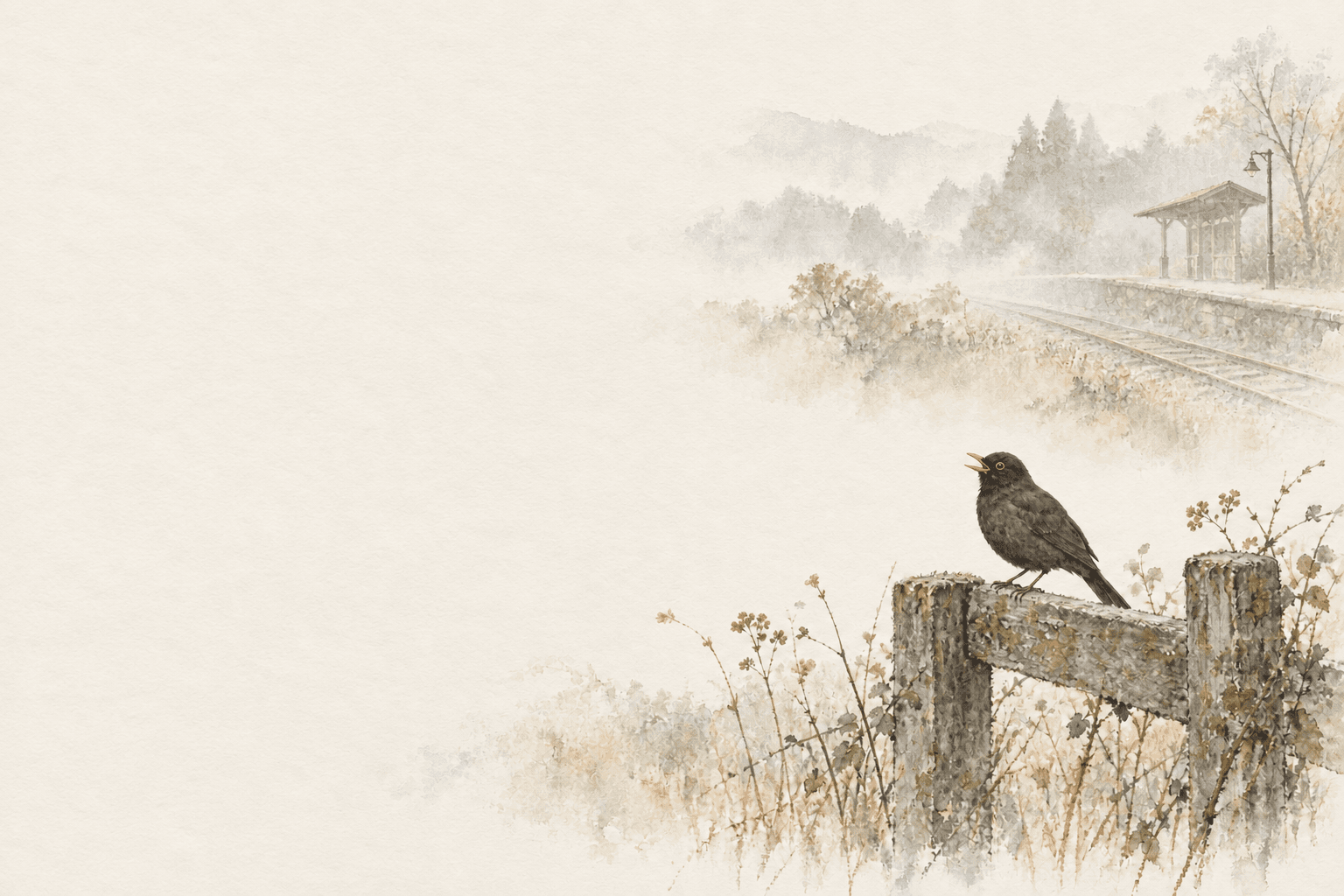
An empty station is quiet at dusk. A blackbird begins to sing from the fence beside the platform. The haiku keeps only the clearest details.
the empty station—a blackbird on the fencebegins to sing
Pause after the first line. It describes the station, while the next two describe the bird. The dash marks this change of subject and helps us notice the contrast between silence and song.
5the empty station—6a blackbird on the fence4begins to sing
Compare the examples
A dash is one way to pause
The words stay the same in all three versions. Compare where and how long you pause with each punctuation choice.
the empty station—a blackbird on the fencebegins to sing
The dash marks a pause after the station. The next two lines describe the blackbird singing.
Published example
Compare sight and sound
A cloud of flowers!Is the bell UyenoOr Asakusa?
What is left unresolved by the question about the bell?
Read an explanation
The poem describes visible blossoms and an audible bell. The speaker asks where the bell is ringing but does not give an answer.
The cut follows “flowers!” The poem changes from describing something seen to asking about something heard.
A dash alone does not create a cut
A dash can mark a pause, but the words on either side need to give us something to compare. “Winter dusk—the evening grows dark” mostly repeats the same information. “Winter dusk—one glove on the rail fills with snow” adds a specific object and action.
Compare the examples
Compare three endings
Try three endings after the same first image. Each creates a different relationship across the pause.
winter dusk—I feel so alonein the quiet street
This names the emotion directly. We understand the speaker’s loneliness, but have less to discover in the images ourselves. This is a demonstration draft.
Compare the examples
Try the cut after line two
The first image can take one line or two. Try both arrangements of this original poem.
first light—a heron liftsfrom the reeds
The first line gives the time of day. The next two describe the heron taking off. The diagram shows the cut after line one.
Try a cut after the first line
Choose two details from the same scene. Describe one in the first line and the other in the next two. Read them with a short pause after the first line.
Remove the punctuation and read again. Can you still identify two distinct parts? In the station example, the change from the place to the bird is clear even without a dash.
Check that each side of the cut adds a different detail. Next, try reading haiku written on one line.